302d Airlift Wing

Air Force Reserve Command

The 302d Airlift Wing's mission is to provide world-class airlift and combat support.

In pursuit of this mission, the 302d Airlift Wing envisions delivering a team of premier Airmen to the combatant command committed and ready to provide rapid global mobility. This vision is achieved by prioritizing the support of combat-ready Airmen who challenge the status quo and strive to develop our future capabilities.

Located at Peterson Space Force Base with a Total Force of more than 1,400 personnel, the Air Force Reserve 302d Airlift Wing trains, equips and employs C-130H aircraft airlift forces in worldwide support of the nation's vital interests. The wing consists of the 302d Operations Group, 302d Maintenance Group, 302d Mission Support Group, 302d Aeromedical Staging Squadron and other subordinate squadrons.

The wing is home to the Air Force Reserve's only aerial firefighting mission using U.S. Forest Service modular airborne firefighting system equipment, commonly referred to as MAFFS.

Units assigned to the 302d AW can be activated and deployed from the United States to any location in the world.

ORGANIZATION:  The 302d AW comes under the operational control of the Air Force Reserve Command, headquartered at Robins AFB, Georgia, through its numbered Air Force, 22nd Air Force, based at Dobbins Air Reserve Base, Georgia, When called to active duty through presidential order, the wing would become an active duty unit under the command of Air Mobility Command, based at Scott AFB, Illinois.

ECONOMIC IMPACT: In Fiscal Year 2024 the value of 302d AW jobs created, annual payroll, and construction services and procurements totaled $76 million dollars.

HISTORY:  Established as the 302d Troop Carrier Wing on May 16, 1949, the 302d AW was first activated by the Air Force Reserve on June 27, 1949. In the mid-1950s, the wing flew airlift operations in the United States and overseas.

The 302d AW was called to active duty during the Cuban missile crisis of 1962. During the 1960s, wing aircraft and crews performed worldwide airlift missions and participated in numerous tactical exercises. The unit was deactivated on April 1, 1981. In mid-1983, the unit, then designated the 901st Tactical Airlift Group, moved to its newly constructed facilities at Peterson SFB and was reactivated as the 302d Airlift Wing on April 1, 1985.  (Additional 302d Airlift Wing history can be found on the 302d AW's HISTORY fact sheet.)

SPECIAL MISSION (MAFFS): The 302d AW is the only Air Force Reserve wing trained and equipped for the Modular Airborne Fire Fighting System (MAFFS) mission, which involves air dropping fire retardant in an effort to aid in the suppression of wildland fires. The U.S. Department of Agriculture Forest Service-owned MAFFS systems can be loaded and installed on a C-130 Hercules aircraft within hours. The wing has flown firefighting missions throughout the Western United States since the 302d AW took on the Reserve portion of the MAFFS mission in 1993.

The MAFFS-equipped C-130s are operated by four military airlift wings: The 146th Airlift Wing, California Air National Guard; 152nd Airlift Wing, Nevada Air National Guard; the 153rd Airlift Wing, Wyoming Air National Guard; and the 302d Airlift Wing, U.S. Air Force Reserve Command.

MAFFS is a mission that highlights interagency cooperation. The 302d AW is a federal force belonging to the Department of Defense, yet works in concert with the National Interagency Fire Center, and the US Forest Service. NIFC determines firefighting needs and strategies. When it is determined MAFFS will be utilized, NIFC through U.S. Northern Command requests the DOD, U.S. Air Force resources. (Additionally, MAFFS-specific information on the 302nd Airlift Wing's MAFFS mission can be found on the MAFFS Tab.

(Current as of March 2025)

302 OG

Commander: 
Lt. Col. Brad Ross

Assigned to the 302nd Airlift Wing, Air Force Reserve, Peterson Space Force Base, Colorado.

Subordinate Units:
34th Aeromedical Evacuation Squadron
302nd Operations Support Squadron
731st Airlift Squadron

302 MXG

Commander: 
Col. Michael P. Spaulding

Assigned to the 302nd Airlift Wing, Air Force Reserve, Peterson Space Force Base, Colorado.

Subordinate Units:
302nd Maintenance Squadron
302nd Aircraft Maintenance Squadron

302 MSG

Commander: 
Col. Gregory Meyer
Assigned to the 302nd Airlift Wing, Air Force Reserve, Peterson Space Force Base, Colorado.

Subordinate Units:
39th Aerial Port Squadron
302nd Civil Engineer Squadron
302nd Force Support Squadron
302nd Logistics Readiness Squadron
302nd Security Forces Squadron
302nd Communications Flight

302 ASTS

Commander: 
Col. Mark E. Shepherd

Assigned to the 302nd Airlift Wing, Air Force Reserve, Peterson Space Force Base, Colorado.

With no subordinate units, the 302 ASTS serves the wing by ensuring its members medical readiness.

C-130 Hercules

Mission

The C-130 Hercules primarily performs the tactical portion of the airlift mission. The aircraft is capable of operating from rough, dirt strips and is the prime transport for airdropping troops and equipment into hostile areas. The C-130 operates throughout the U.S. Air Force, serving with Air Mobility Command, Air Force Special Operations Command, Air Combat Command, U.S. Air Forces in Europe, Pacific Air Forces, Air National Guard and the Air Force Reserve Command, fulfilling a wide range of operational missions in both peace and war situations. Basic and specialized versions of the aircraft airframe perform a diverse number of roles, including airlift support, Antarctic ice resupply, aeromedical missions, weather reconnaissance, aerial spray missions, firefighting duties for the U.S. Forest Service and natural disaster relief missions.

Features

Using its aft loading ramp and door, the C-130 can accommodate a wide variety of oversized cargo, including everything from utility helicopters and six-wheeled armored vehicles to standard palletized cargo and military personnel. In an aerial delivery role, it can airdrop loads up to 42,000 pounds or use its high-flotation landing gear to land and deliver cargo on rough, dirt strips.

The flexible design of the Hercules enables it to be configured for many different missions, allowing one aircraft to perform the role of many. Much of the special mission equipment added to the Hercules is removable, allowing the aircraft to return to its cargo delivery role if desired. Additionally, the C-130 can be rapidly reconfigured for the various types of cargo such as palletized equipment, floor-loaded material, airdrop platforms, container delivery system bundles, vehicles and personnel or aeromedical evacuation.

The C-130J is the latest addition to the C-130 fleet and has replaced aging C-130Es and some of the high time C-130Hs. The C-130J incorporates state-of-the-art technology, which reduces manpower requirements, lowers operating and support costs, and provides life-cycle cost savings over earlier C-130 models. Compared to older C-130s, the J model climbs faster and higher, flies farther at a higher cruise speed, and takes off and lands in a shorter distance. The C-130J-30 is a stretch version, adding 15 feet to the fuselage, increasing usable space in the cargo compartment.

C-130J/J-30 major system improvements include advanced two-pilot flight station with fully integrated digital avionics, color multifunctional liquid crystal and head-up displays and state-of-the-art navigation that includes a dual inertial navigation system and GPS. The aircraft also features fully integrated defensive systems, low-power color radar, digital moving map display, new turboprop engines with six-bladed all-composite propellers and a digital auto pilot. The C-130J/J-30 also includes improved fuel, environmental and ice-protection and an enhanced cargo-handling system.

Background

The Air Force issued its original design specification in 1951, yet the remarkable C-130 remains in production. The initial production model was the C-130A, with four Allison T56-A-11 or -9 turboprop engines. A total of 219 were ordered and deliveries began in December 1956. The C-130B introduced Allison T56-A-7 turboprop engines and the first of 134 entered Air Force service in May 1959.

Introduced in August of 1962, the 389 C-130Es that were ordered using the same Allison T56-A-7 engine, but added two 1,290 gallon external fuel tanks and an increased maximum takeoff weight capability. June 1974 introduced the first of 308 C-130Hs with the more powerful Allison T56-A-15 turboprop engine. Nearly identical to the C-130E externally, the new engine brought major performance improvements to the aircraft.

The latest C-130 to be produced, the C-130J, entered the inventory in February 1999. With the noticeable difference of a six-bladed composite propeller coupled to a Rolls-Royce AE2100D3 turboprop engine, the C-130J brings substantial performance improvements over all previous models. The C-130J-30, a stretch version with a 15-foot fuselage extension, increases the capabilities even more. To date, the Air Force has taken delivery of 121 C-130J aircraft from Lockheed-Martin Aeronautics Company.

Active-duty locations for the C-130 and its variations are Dyess Air Force Base, Texas; Little Rock AFB, Arkansas; Ramstein Air Base, Germany; and Yokota AB, Japan.

Air Force Reserve locations for assigned C-130 models are Dobbins Air Reserve Base, Georgia; Keesler AFB, Mississippi; Maxwell AFB, Alabama; Minnesota-St. Paul Joint Air Reserve Station, Minnesota; Peterson AFB, Colorado; and Youngstown ARS, Ohio.

Air National Guard locations for the C-130 and its variations are Bradley Air National Guard Base, Connecticut;  Joint Reserve Base Carswell, Texas; Channel Island ANG Station, California; Cheyenne Municipal Airport, Wyoming; Great Falls ANGB, Montana; Little Rock AFB, Arkansas; Louisville IAP, Kentucky; Mansfield Lahm ANG Base, Ohio;  Minnesota-St. Paul ARS, Minnesota;  Muñiz ANGB, Puerto Rico; New Castle County ANGB, Delaware; Greater Peoria Regional Airport, Illinois; Quonset State Airport, Rhode Island; Reno-Tahoe IAP, Nevada; Savannah IAP, Georgia; Schenectady MAP, New York; Rosecrans Memorial Airport, Missouri; and Yeager Airport, West Virginia.

General Characteristics

Primary Function: Global airlift

Contractor: Lockheed-Martin Aeronautics Company

Power Plant:

C-130E: Four Allison T56-A-7 turboprops; 4,200 prop shaft horsepower

C-130H: Four Allison T56-A-15 turboprops; 4,591prop shaft horsepower

C-130J: Four Rolls-Royce AE 2100D3 turboprops; 4,700 horsepower

Length: C-130E/H/J: 97 feet, 9 inches (29.3 meters)

C-130J-30: 112 feet, 9 inches (34.69 meters)

Height: 38 feet, 10 inches (11. 9 meters)

Wingspan: 132 feet, 7 inches (39.7 meters)

Cargo Compartment:

C-130E/H/J: length, 41 feet (12.5 meters); width, 123 inches (meters); height, 9 feet (2.74 meters). Rear ramp: length, 119 inches (36.27 meters); width, 118.9 inches (3.02 meters)

C-130E/H/J-30: length, 56 feet (16.9 meters); width, 123 inches (3.12 meters); height, 9 feet (2.74 meters). Rear ramp: length, 119.9 inches (3.12 meters); width, 118.9 inches (36.24 meters)

Speed:

C-130E: 345 mph/300 ktas (Mach 0.49) at 20,000 feet (6,060 meters)

C-130H: 366 mph/318 ktas (Mach 0.52) at 20,000 feet (6,060 meters)

C-130J: 417 mph/362 ktas (Mach 0.59) at 22,000 feet (6,706 meters)

C-130J-30: 410 mph/356 ktas (Mach 0.58) at 22,000 feet (6,706 meters)

Ceiling:

C-130J: 28,000 feet (8,615 meters) with 42,000 pounds (19,090 kilograms) payload

C-130J-30: 26,000 feet (8,000 meters) with 44,500 pounds (20,227 kilograms) payload.

C-130H: 23,000 feet (7,077 meters) with 42,000 pounds (19,090 kilograms) payload.

C-130E: 19,000 feet (5,846 meters) with 42,000 pounds (19,090 kilograms) payload

Maximum Takeoff Weight:

C-130E/H: 155,000 pounds (69,750 kilograms)

C-130J: 164,000 pounds (74,393 kilograms)

Maximum Allowable Payload:

C-130E, 42,000 pounds (19,090 kilograms)

C-130H, 42,000 pounds (19,090 kilograms)

C-130J, 42,000 pounds (19,090 kilograms)

C-130J-30, 44,000 (19,958 kilograms)

Maximum Normal Payload:

C-130E, 36,500 pounds (16,590 kilograms)

C-130H, 36,500 pounds (16,590 kilograms)

C-130J, 34,000 pounds (15,422 kilograms)

C-130J-30, 36,000 pounds (16,329 kilograms)

Range at Maximum Normal Payload:

C-130E, 1,150 miles (1,000 nautical miles)

C-130H, 1,208 miles (1,050 nautical miles)

C-130J, 2,071 miles (1,800 nautical miles)

C-130J-30, 1,956 miles (1,700 nautical miles)

Range with 35,000 pounds of Payload:

C-130E, 1,438 miles (1,250 nautical miles)

C-130H, 1,496 miles (1,300 nautical miles)

C-130J, 1,841 miles (1,600 nautical miles)

C-130J-30, 2,417 miles (2,100 nautical miles)

Maximum Load:

C-130E/H/J: 6 pallets or 72 litters or 16 CDS bundles or 90 combat troops or 64 paratroopers, or a combination of any of these up to the cargo compartment capacity or maximum allowable weight.

C-130J-30: 8 pallets or 97 litters or 24 CDS bundles or 128 combat troops or 92 paratroopers, or a combination of any of these up to the cargo compartment capacity or maximum allowable weight.

Crew: C-130E/H: Five (two pilots, navigator, flight engineer and loadmaster)

C-130J/J-30: Three (two pilots and loadmaster)

Aeromedical Evacuation Role: A basic crew of five (two flight nurses and three medical technicians) is added for aeromedical evacuation missions. Medical crew may be decreased or increased as required by the needs of patients.

Unit Cost: C-130E, $11.9, C-130H, $30.1, C-130J, $75.5 (FY 2017 Then dollars in millions)

Date Deployed: C-130A, Dec 1956; C-130B, May 1959; C-130E, Aug 1962; C-130H, Jun 1974; C-130J, Feb 1999

Inventory: Active force, 145; Air National Guard, 181; Air Force Reserve, 102

(Current as of June 2018)
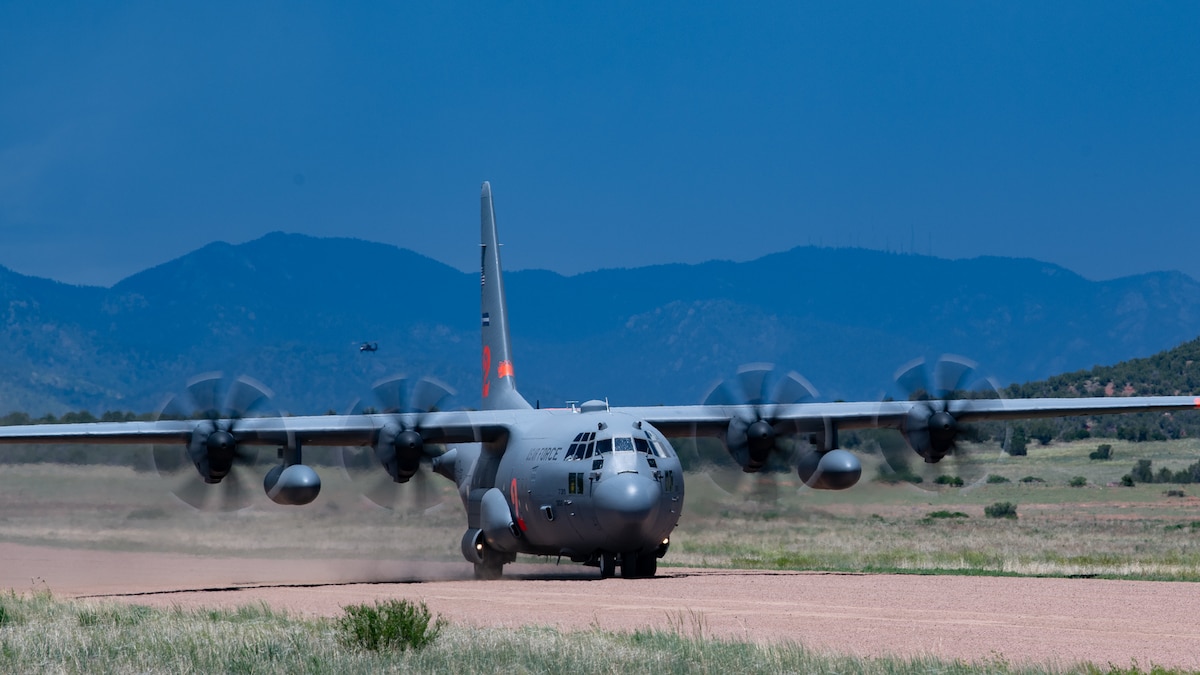
A military cargo aircraft takes off at a dirt airstrip with a second aircraft in the background.

Modular Airborne Fire Fighting System (MAFFS)

In the 1970s, Congress established the Modular Airborne Fire Fighting System (MAFFS) Program to aid the United States Department of Agriculture Forest Service. Typically, when all other civilian air tankers are activated but further assistance is needed, the U.S. Forest Service, through the National Interagency Fire Center (NIFC), can request the aid of the U.S. Air Force's MAFFS flying units.

MAFFS is a mission that highlights interagency cooperation. The 302nd Airlift Wing is a federal force belonging to the Department of Defense, yet works in concert with NIFC and the U.S. Forest Service. NIFC serves as a focal point for coordinating the national mobilization of resources for wildland fire. When it is determined MAFFS will be utilized, NIFC through U.S. Northern Command requests the DoD, U.S. Air Force resources.

One Air Force Reserve and three Air National Guard locations participate in the MAFFS Program. The 302nd Airlift Wing, Peterson Space Force Base, Colorado Springs, Colorado, is the only Air Force Reserve unit supporting the aerial firefighting mission. The Air National Guard units supporting MAFFS include the 146 AW in Channel Islands, Air National Guard Base, California, the 152 AW based in Reno, Nevada, and the 153 AW based at Cheyenne, Wyoming. Each flying unit stores and is ready to activate two of the MAFFS units for a total of eight nationwide.

In 1993 the Air Force Reserve Command portion of the MAFFS mission was moved to the 302nd Airlift Wing from March Air Force Base, California. When the 943 AG was deactivated, the MAFFS units were transferred to the 302 AW and the wing performed their first training with the U.S. Forest Service in Boise, Idaho, in May. On Oct. 28, 1993, two aircrews from the 731st Airlift Squadron and maintenance personnel from the 302nd Maintenance Group departed for Point Mugu Naval Air Warfare Center, California, for their first MAFFS activation.

Crews who fly MAFFS missions participate with the U.S. Forest Service in annual currency/re-currency certification. Each wing is required to have five certified crews for each MAFFS unit.

The U.S. Forest Service-owned MAFFS units fit inside the C-130 Hercules aircraft without requiring structural modification to the airframe. This allows the units to be loaded on short-notice. MAFFS units can drop either water or fire retardant.

It takes approximately four hours to load and install a MAFFS unit in the C-130. A MAFFS unit can discharge its load - 3,000 gallons weighing 27,000 pounds - in less than five seconds. The retardant can cover an area one-quarter of a mile long and 100 feet wide. After the plane discharges its load, it can be refilled in less than 12 minutes.

In February 2009, a new generation MAFFS unit was declared fully operational. Known as MAFFS II, the system evolved into a single-tank platform with a self-contained system to pressurize the retardant tank. This enables MAFFS II to operate without a ground based air compressor and access many more reload bases, reducing the amount of ground support personnel needed as well as allowing more firefighting missions to be flown on any given day.

MAFFS RECENT HISTORY

2018 marked 25 years of support from Reserve Citizen Airmen of the 302 AW for the MAFFS program at Peterson SFB, Colorado. The 302 AW was first activated on July 2, 2018, to support fires in the Colorado area. Both MAFFS 2 and 5 were tasked to support these operations from July 2 through July 9. The tasking consisted of 46 sorties, 49.1 hours, 54 drops delivering 123,284 gallons of retardant weighing 1,106,607 pounds supporting 6 different fires in Colorado and Wyoming. One plane each from the 152 AW and the 153 AW also supported the operation starting on July 5 and deactivating completely on July 12. 

MAFFS was tasked again shortly after conclusion of the first 2018 RFA. USFS requested support for 2 aircraft at McClellan Air Park, California, starting July 23. This tasking was initially fulfilled by the 146 AW, joined by the 152 AW and 153 AW on July 30. The 302 AW joined the operation on Aug. 8. During this activation the 302 AW provided 1 aircraft/crew at McClellan Air Park and flew 14 sorties, 16.0 hours and 15 drops totaling 41,108 gallons and 368,738 pounds of retardant supporting 6 fires in California.

Due to low fire potentials in 2019 across the Western U.S., and elevated conditions isolated to the Northwest and California, MAFFS was not mobilized. The 302 AW did participate in an airborne aerial firefighting demonstration at the AirVenture Oshkosh Airshow and provided a MAFFS static display at Feria Aeroespacial México - FAMEX 2019, the largest airshow in Latin American, held at a Mexican Air Force Base in Mexico City.

In 2020, MAFFS was mobilized on July 23 to support firefighting activity in California. The original RFA was for 2 tails and the 302 AW was tasked with providing 1 MAFFS aircraft at McClellan Air Park, Cali., from July 29 through Aug. 12. On Aug. 15, the RFA was amended to 4 tails. On the same day, the 302 AW experienced a significant hail storm at home station that rendered its C-130 fleet grounded due to hail damage. However, the 153 AW loaned MAFFS 1 to the 302 AW to fly MAFFS missions at McClellan Air Park, CA, from Aug. 26 through Sept. 2. The 934 AW at Minneapolis, Minn., loaned a tail to the 302 AW which was quickly prepped for MAFFS and deployed as MAFFS 2 to McClellan on Sept. 2 through Sept. 17. On Sept. 30, several 302 AW crew members “rainbowed” with 152 AW and 153 AW crews on their tails until the RFA was terminated on Oct. 3. The 302 AW performed 60 drops on 17 different fires in California, flying 73.3 hours, and delivering 166,713 gallons of retardant weighing 1,500,417 pounds. 

Despite an ongoing worldwide pandemic, COVID-19, MAFFS training was completed in May, 2021, and mobilized on June 26 to support firefighting activity in California. The original RFA was for 2 tails, and quickly amended to 3 tails on July 2. By July 27, the RFA was increased to 5 tails, and on Aug. 9 it increased to 6 tails. The RFA was further increased to 8 tails on Aug. 26. It was curtailed to 4 tails on Sept. 22 and ended on Sept. 29.

The 302 AW deployed MAFFS 2 to McClellan on July 20 with MAFFS 5 joining the fight on Aug. 4. Due to conflicting requirements levied on other MAFFS wings, the AEG made a rare request that the 302 AW provide a third MAFFS aircraft to the fight. On Aug. 24, an additional 302 AW aircraft and crew marked as MAFFS 8 deployed to McClellan to meet the 8-ship RFA. The 302 AW maintained 3 MAFFS aircraft and required personnel at McClellan through Sept. 22, when MAFFS 8 was released. MAFFS 2 and 5 stayed in-service until Sept. 29. In total as of Oct. 7, 2021, the 302 AW has performed 259 drops on 26 fires in California, flown 251.3 hours and delivered 730,261 gallons of retardant (over 6.5 million pounds). 

On Apr. 23, 2022, 302 AW's MAFFS 2 and 5 departed for and arrived at Boise Air Tanker Base with all-instructor crews. The main body arrived via organic airlift on Apr. 24 with academic training being conducted Apr. 24-25. All required annual training on MAFFS systems and USAF procedures was accomplished, along with biennial USFS training events. The 302 AW also provided instructor pilot support for the Reno ANG, 152 AW, during their mobilization Sep. 14 with two drops and a total dispersion of 2,786 gallons of retardant. They also supported the Pikes Peak Regional Airshow with a MAFFS demonstration flyover Sep. 24-25. 

(Current as of October 2022)

302d Airlift Wing History

The Air Force Reserve Command’s 302d Airlift Wing is located at Peterson Space Force Base, Colo. Approximately 1,300 Reserve Airmen are assigned, of which roughly 200 are full-time dual-status Air Reserve Technician employees.

The mission of the 302d AW is to train, equip and employ mission ready Airmen in support of the nation’s global operations requirements. The primary operational mission of the 302d AW is tactical airlift and airdrop utilizing the wing’s eight C-130H assigned aircraft. The wing is also the only Air Force Reserve Wing, along with three Air National Guard Wings, supporting the C-130 special mission of aerial firefighting, employing the U.S. Forest Service's Modular Airborne Fire Fighting Systems (MAFFS). The MAFFS mission was moved to the Colorado-based wing in 1993.

Established as the 302d Troop Carrier Wing on May 16, 1949, and based at Clinton County AFB, Ohio, the 302nd AW was first activated by the Air Force Reserve on June 27, 1949. In the mid-1950s, the wing flew airlift operations in the United States and overseas.

The 302d AW was called to Active Duty during the Cuban missile crisis of 1962. During the 1960s, wing aircraft and crews performed worldwide airlift missions and participated in numerous tactical exercises. The unit was deactivated on April 1, 1981. In mid-1983, the unit, then designated the 901st Tactical Airlift Group, moved to its newly constructed facilities at Peterson AFB and was reactivated as the 302nd Airlift Wing on April 1, 1985.

The wing received one of its most challenging tests in 1990-1991 with Operations Desert Shield and Desert Storm. More than 600 wing members, including flying, medical and maintenance personnel, deployed to the Persian Gulf, England and stateside locations to support Active Duty operations.

At the end of the Gulf War, the 302d AW supported Operation Provide Comfort, air dropping food and supplies to Kurdish refugees. The wing also supported Operations Restore Hope in Somalia, Coronet Oak in Panama, Provide Promise’s humanitarian airlift to Bosnia and hurricane relief to Homestead AFB, Fla.

In 1999, the wing assisted in humanitarian relief to refugees from Kosovo and Operation Allied Force.

Since 2001, Airmen from throughout the wing to include the mission areas of aircrew, aircraft maintenance, aeromedical evacuation, aerial port, logistics, security forces, civil engineer, communications, medical, public affairs, legal, financial management, chaplain, as well as aircraft from the 302d AW have been deployed in support of numerous operations to include: Operations Noble Eagle, Enduring Freedom, Iraqi Freedom, New Dawn, Inherent Resolve, and Freedom’s Sentinel. In 2010 the wing provided humanitarian aid relief in Haiti during Operation Unified Response and also supported flood relief in Pakistan.

In 2015, the 302d Airlift Wing was named the Lt. Gen. James E. Sherrard, III, Air Force Reserve Outstanding Air Mobility Wing by the Airlift/Tanker Association recognizing the wing’s contribution to the overall success of the Mobility Air Force mission and total force.

The wing has earned recognition earning the Air Force Outstanding Unit Award multiple times to include awards for the periods of 1990-1991, 1998-1999, 2001-2002, 2004-2006, 2006-2008, 2009-2011 and most recently for 2015.

(Current as of October 2021)

FY25-26 UTA Schedule

Aug 25
2-3
Mar 26
6-8
Sep 25
6-7
Apr 26
none
Oct 25
3-5
May 26
1-3
Nov 25
none
June 26
5-7
Dec 25
5-7
July 26
none
Jan 26
none
Aug 26
7-9
Feb 26
6-8
Sep 26
11-13

** Unit Commanders may reschedule Inactive Duty Training for the entire unit, team, or an individual reservist. Members should confirm Unit Training schedules with their commanders. 

302 AW Contacts

Public Affairs (719) 556-4117
Military Pay (719) 556-8187
Force Support (719) 556-7975

302 AW Mailing Address

450 W Hamilton Ave.
Bldg 625, Suite 104
Peterson SFB, CO, 80914-2253

Other Contacts

For DD214 requests, retirements, separations, benefits and more, call the Total Force Service Center at 1-800-525-0102 or DSN 665-0102.

Interested in joining the 302d Airlift Wing at Peterson Space Force Base, Colorado? 

Contact our Recruiting Office at (719) 726-4380.

Commander

Deputy Commander

Command Chief

Information